Delivery Tips:
Note the warehouse’s receiving hours, which are usually from 9:00 AM to 11:00 PM. Deliveries outside of business hours may incur an overtime service fee of 100–200 RMB.
After the driver arrives at the warehouse, they must wait in line to unload the goods. Once unloading is complete, they must present the shipping manifest at the check-in counter to complete the warehousing procedures, at which point the handover is officially finalized.
Step 4: Calculate the “Costs” — What Do the Fees Include?
Keep in mind that the total cost is not limited to just shipping fees.
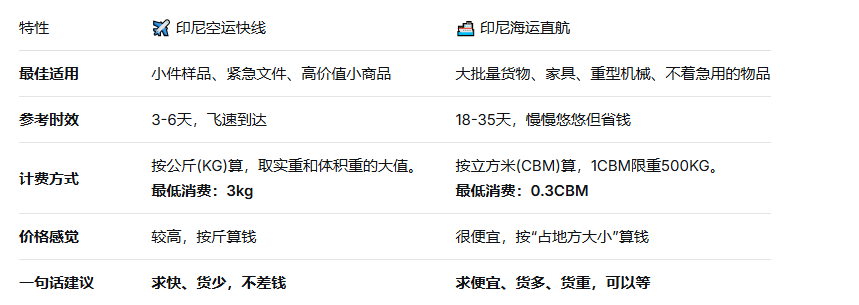
Core Shipping Fees: Air freight is calculated by weight (per kilogram), while sea freight is calculated by volume (per cubic meter), based on the shipping method you select.
Common Additional Fees:
Customs Clearance Fee: Sea freight typically includes a fixed customs clearance fee (e.g., 650 RMB per shipment).
Brand Surcharge: For air freight, shipping branded goods (such as Nike shoes) usually incurs an additional 5 RMB per kilogram.
Remote Delivery Fee: If the delivery address is outside Jakarta, an additional delivery fee will apply.
Warehouse Handling Fee: If you require the warehouse to assist with packing, stretch wrapping, or label application, standard fees will apply.
Insurance Fee (Highly Recommended): You must purchase declared value insurance for high-value goods! The insurance fee for sea freight is generally around 3% of the declared value. If you do not purchase it, in the event of loss, you may only be compensated 2–3 times the shipping cost, resulting in significant financial loss.
Step 5: Keep a Close Eye on Your “Cargo” — Key Points for Tracking and Signing for Delivery
After the goods are shipped, you will receive a waybill number that allows you to track the shipment throughout the entire process.
Top Priority: Inspection Upon Signing for the Shipment!
Once the goods arrive in Indonesia, the recipient must inspect them before signing for them!
First: Check if the number of outer packages matches the count.
Second: Check if the outer packaging shows any signs of damage, deformation, or tampering.
If there are abnormalities: Clearly note them on the delivery receipt on the spot, such as “Outer packaging damaged; must open to inspect,” and take photos or videos as evidence.
No issues: Once you write “in good condition” or leave no remarks on the receipt, the logistics company will assume the goods are problem-free. If you later discover missing or damaged items, it will be virtually impossible to file a claim!
Finally, here are 3 pieces of advice you must remember:
Always declare accurately: Do not undervalue the goods or conceal the product name. If caught by customs, you will face fines and confiscation.