Brazilian Customs Clearance Process and Tariff Rates: A Guide to Avoiding Pitfalls and an Interpretation of the 2026 Policy Changes for Cross-Border Sellers
Brazil, South America’s largest market, is also a “hellish challenge” for cross-border e-commerce. With difficult customs clearance, numerous tax categories, and rapidly changing policies, the 2026 regulations present even more pitfalls. This article provides a comprehensive overview of the Brazilian customs clearance process and the latest tariff rates; we recommend reviewing it before shipping.
I. The “Three-Color Lanes” of Customs Clearance: Green (Fast), Yellow (Slow), Red (Dead)
Brazilian customs uses the Siscomex system, which automatically sorts incoming goods into three lanes upon arrival:
Green: Automatic release—the fastest and most hassle-free option.
Yellow: Documents are held for manual review.
Red: The most critical. Both documents and physical goods are inspected, leading to container opening, fines, and demurrage charges.
Special Note for 2026: Brazil has launched the new DUIMP system; conduct data pre-review before shipping. Even a single word error in the customs code (NCM) or physical description on the invoice will almost certainly result in the shipment being routed to the red channel.
Red Line Warning: Do not undervalue the goods. Brazilian Customs maintains a global price database; if discovered, you will be required to pay the difference plus a 100% punitive fine, and they may retroactively audit shipments for up to three years.
II. The Four Essential Documents for Customs Clearance—Not One Can Be Missing
Commercial Invoice: It is recommended to include a Portuguese translation. Must clearly state the importer’s CNPJ (Corporate Tax ID). The product description must be detailed enough to include “brand + material + model”; simply writing “clothing” is insufficient.
Original Bill of Lading: Certain forms of electronic release bills of lading are not accepted.
Import License (RADAR): The importer must hold a valid Brazilian tax ID. Using someone else’s tax ID for “full clearance with tax included” carries extremely high risks and may result in the goods becoming unclaimed.
Mandatory Certification: Electronics require ANATEL or INMETRO certification; medical devices, food, and cosmetics require ANVISA certification. No certification = no clearance.
III. 2026 Latest Tax Rates: The Terrifying “Tax on Tax”
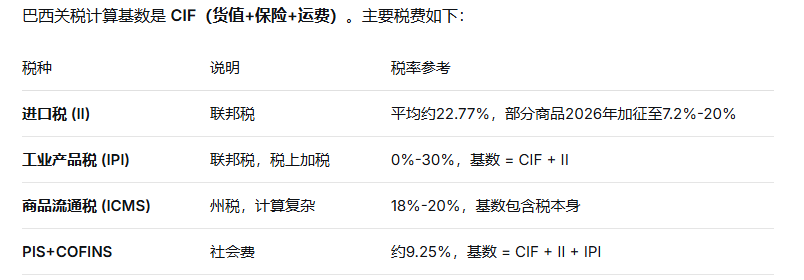
To give a simplified example: for goods valued at 100 yuan, taxes and fees often amount to 60%–100% of the CIF price.
Special Note for Cross-Border E-Commerce: Starting in 2026, tax exemptions for small packages under $50 will be eliminated, and a uniform 60% import tax plus ICMS will be levied, bringing the “rock-bottom pricing” model to a complete end.
IV. Survival Rules for Sellers in 2026
Abandon any hopes of getting away with it: Do not undervalue shipments or use gray-market customs clearance.
Calculate Taxes in Advance: Base pricing on a CIF value multiplied by 1.6 or higher.
Complete Certifications Early: For products requiring certification, ensure all certifications are obtained before shipping.
Declare in Compliance: Use your own CNPJ for proper customs clearance, or work with an agent who can provide official tax invoices.
Brazil has high entry barriers, but it also offers high returns. Understanding the rules makes it a market worth investing in.
Translated with DeepL.com (free version)