A Detailed Guide to Ocean Freight Solutions: The Optimal Balance of Cost and Capacity
When choosing ocean freight, the decision is primarily based on three factors: mode of transport, transit time, and cost.
1. Should you choose a full container load (FCL) or less than container load (LCL)?
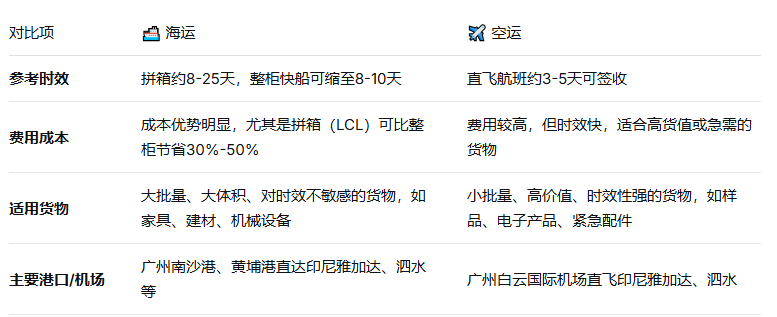
Full Container Load (FCL): If your cargo can fill a 20-foot or 40-foot container, this is the preferred option. Your cargo is loaded into a dedicated container, ensuring high security and fast transit times. Since the container is not opened en route, the risk of cargo damage is significantly reduced.
Less than Container Load (LCL): If your shipment volume is insufficient to fill a full container, this is the most economical option. Cargo from multiple shippers is consolidated into a single container, significantly reducing costs. However, the process is more complex, transit times are slightly longer, and there is a certain risk of cargo damage.
2. How long does it take?
Direct Express Service: Departing from Nansha Port in Guangzhou, the fastest transit time to Jakarta is just 4–5 days. Including loading/unloading and customs clearance at both ends, the entire process can be completed in 8–10 days.
Transit Service: If the voyage requires transshipment via Singapore or other ports, the total transit time may be 15–25 days.
3. How are costs calculated?
Ocean freight costs primarily consist of three components. Below are reference ranges for general cargo shipments to Jakarta:
Base Freight: Approximately $80–150 per cubic meter.
Surcharges: Such as fuel surcharges and peak season port congestion surcharges, which account for approximately 15%–20% of the base freight.
Handling fees: Including document processing and customs clearance fees, approximately $130–180 per shipment.
Important note: For shipments under 1 cubic meter or 100 kg, many logistics companies apply a “minimum charge,” with a starting rate of approximately $300–400 per shipment. Be sure to confirm this with your freight forwarder before shipping.
Air Freight Overview: The Leader in Speed and Flexibility
Transit Time: The core advantage of air freight is speed. With direct flights from Guangzhou to Jakarta or Surabaya, shipments can reach customers in 3–5 days, making it ideal for urgent restocking, sending samples, or fulfilling unexpected orders.
Service: Many dedicated air freight lines offer “door-to-door” service, picking up goods directly from your location and delivering them to the destination, eliminating intermediate steps and providing great convenience.
Suitability: Ideal for small, high-value, or time-sensitive shipments. For large, heavy cargo, air freight costs rise sharply, making it far less cost-effective than sea freight.
Customs Clearance Is Paramount: The Key Hurdle for the Indonesian Market
Whether you choose sea or air freight, customs clearance is the most critical step, especially given that Indonesian customs is known for its strictness and complexity.
Documents Must Be Complete: The commercial invoice, packing list, and bill of lading are the three essential documents for customs clearance. For trade with ASEAN countries, it is recommended to obtain the FORM E Certificate of Origin in advance to qualify for tariff reductions—do not overlook this step.
Be Aware of Sensitive Goods: Food, cosmetics, electronics, and other items fall under the category of sensitive goods. Clearing these through Indonesian customs requires additional import permits (such as BPOM certification from the Food and Drug Administration or SNI national standard certification), which involves more complex procedures and higher costs. Be sure to confirm whether your products fall into this category before shipping.
Avoid the Risks of Mixed Loading: It is absolutely critical to ensure that general cargo and sensitive goods are never loaded together in the same container. If inspected, the likelihood of detention is extremely high, potentially leading to the entire container being seized or even returned, resulting in significant losses.
Ensure Packaging Compliance: If using wooden packaging (such as wooden crates or pallets), it must undergo fumigation and be clearly marked with the IPPC (International Plant Protection Convention) logo. Failure to do so may result in fines or clearance denial upon arrival at the port.
How to Choose a Logistics Provider?