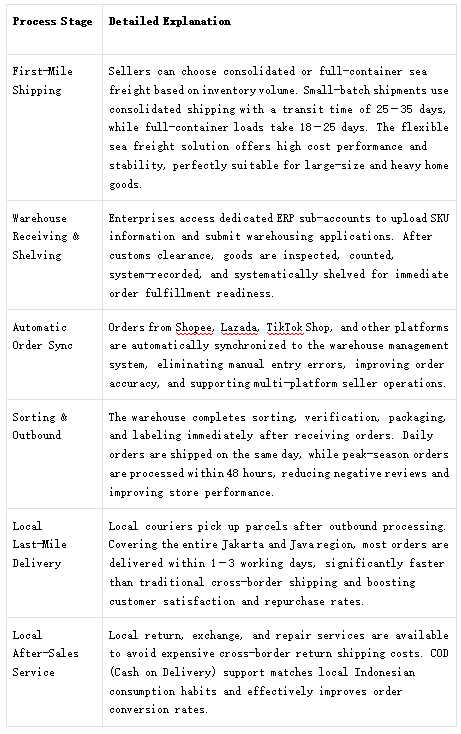
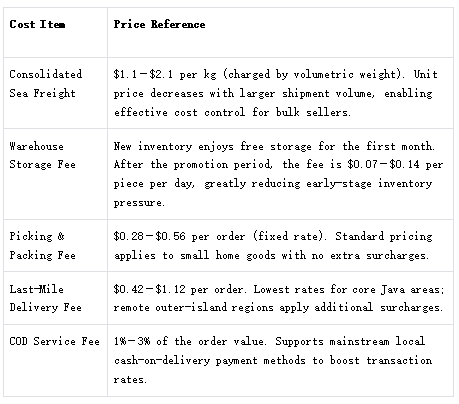
In general, the comprehensive fulfillment cost of Jakarta Indonesia home goods overseas warehouse dropshipping is stably maintained at $2.1 to $3.5 per order. Small-sized and lightweight home goods enjoy lower unit costs, while large-size, heavy-weight products and orders delivered to remote outer-island areas require a reasonable cost premium. Compared with traditional international direct mail, Indonesia local overseas warehouse fulfillment delivers faster delivery timelines, lower comprehensive operational costs, and better platform store weight, making it the dominant high-ROI solution for home goods cross-border expansion in Indonesia.
4. Professional Warehouse Selection Guide | Indonesia Home Goods Cross-Border Sellers
Home goods feature diverse SKUs, variable product sizes, bulky volume, and moderate weight, which directly determine the overall operational cost and fulfillment experience of cross-border stores. When deployingJakarta overseas warehouse dropshipping business, sellers need to select warehouses targeting the characteristics of Indonesian home goods e-commerce to effectively avoid fulfillment delays, cost waste, and after-sales risks.
1. Prioritize Core Logistics Hub Locations: Choose warehouses near Tanjung Priok Port and Soekarno-Hatta Airport. Premium locations ensure fast first-mile transit, fewer transfers, full nationwide delivery coverage, and stable lead times.
2. Verify Billing Rules for Cost Control: Warehouses adopt either per-piece or volumetric billing models, which create huge long-term cost differences. Sellers should match the most suitable billing method according to product size and attributes to optimize warehouse expenses.
3. Support Brand Value-Added Services: Brand-focused sellers are recommended to select warehouses offering relabeling, custom packaging, and private-label services to enhance product premium and localized brand competitiveness.
4. Test Small Batches Before Scaling Up: Run small-batch inventory tests to verify warehouse efficiency, service stability, and after-sales performance before large-scale stocking, effectively avoiding inventory risks.
5. Adapt to Multi-Platform Order Systems: For sellers operating on Shopee, Lazada, and TikTok Shop simultaneously, choose warehouses with high system compatibility to realize automatic order synchronization, unified management, and centralized fulfillment for simplified operations.
5. Conclusion
For cross-border enterprises exploring the Indonesian blue-chip home goods market, Jakarta home goods overseas warehouse dropshipping is the most mature, stable, and implementable local fulfillment solution. Supported by complete local logistics infrastructure, standardized Indonesia home goods dropshipping procedures, open and transparent pricing mechanisms, and professional localized after-sales services, overseas warehouses effectively solve the core pain points of slow delivery, high negative review rates, low order conversion, and difficult after-sales processing under traditional cross-border models. By adopting scientific warehouse selection standards, compliant inventory preparation, and gradual scaled operation, sellers can quickly capture the huge consumer demand of Indonesia’s home goods market, continuously improve local store weight and order volume, and achieve long-term stable development of cross-border e-commerce business.